Agents on the manufacturing chain: finding the break between purchase order and finished goods
How we used agentic engineering to solve a problem that sat between the steps of an ERP manufacturing chain, not inside any one of them.
- Industry
- Manufacturing
- Timeline
- Delivered in 2026
- Client
- Manufacturing company (anonymised)
01 — Challenge
The problem
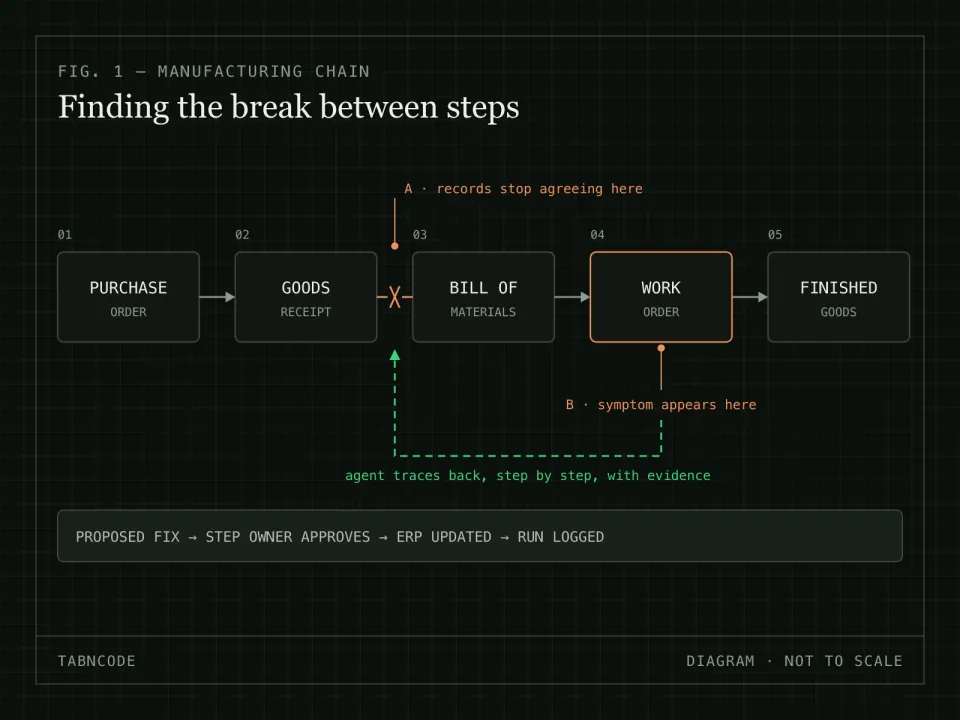
A manufacturing chain in an ERP is a relay. A purchase order becomes received stock, stock is committed to a bill of materials, the bill of materials drives a work order, and the work order becomes finished goods that can be sold. Each step has its own records, its own owner and its own screen, and each one usually looks correct when you open it by itself.
The problem we were asked to solve lived in the hand-offs. When the records of one step fall out of line with the next, nobody sees it at the point where it happens. It surfaces later and further down the chain, as a work order that cannot start or a quantity that does not add up, and finding the cause means a person walking back through the chain record by record. That is slow, it depends on the few people who know the whole chain, and it has to be repeated every time.
02 — Solution
What we built
We treated it as an agentic engineering problem: work that is mostly reading, cross-checking and following a trail through structured records, which is what agents are good at, with a small number of decisions that must stay with people.
The agents were given read access to the chain and a narrow set of tools, one per kind of record. Given a symptom at one step, an agent follows it backwards through the chain, compares what each step recorded with what the step before it handed over, and reports where the two stop agreeing, with the records it used as evidence. It works the way an experienced ERP consultant does, and it shows its trail so that a person can check it.
What the agents cannot do matters as much. They do not write to the ERP by themselves. A correction is proposed with its reasoning and the affected records, and a person who owns that step approves it before anything changes. Every run is logged, so a wrong conclusion can be traced to the step where the agent went wrong and the instructions or tools improved.
We built it the way we build other AI systems: starting from real cases the team had already solved by hand, using them as the test set, and only widening the agents' scope once they reached the same answers the people had.
Stack & scope
- Agentic engineering
- ERP
- Manufacturing
- Work orders
- Human approval
- Audit trail
Next step
Want results like these?
Tell us what you want to build. In a 30-minute session we map the scope, the risks and the fastest route to something running.
We reply within 24h · hello@tabncode.com